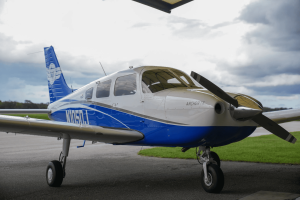
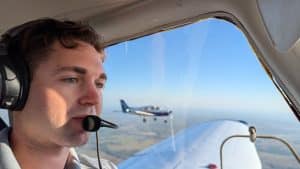
N488DJ over Central Florida at sunset.
If you’re searching for a flight school near Orlando Sanford International Airport, there’s a good chance you’d actually like to train at Orlando Sanford International Airport. Crazy concept, I know.
Central Florida has plenty of places to learn how to fly, although driving across Orlando traffic every time you have a lesson gets old pretty quickly. If Sanford is convenient for you, it makes sense to look for a school with airplanes based at KSFB, instructors who fly there every day, and an actual operation on the field.
There are also some pretty significant benefits to learning at Sanford beyond the convenience.
Here’s what I would look at when comparing flight schools near KSFB, what you can expect from training at a Class C airport, and a little about what we’re doing at D&J Aviation’s Sanford location.
Why KSFB Is a Great Place to Learn to Fly
Orlando Sanford International is a busy, towered Class C airport with commercial airline traffic operating alongside general aviation.
For a new student pilot, that sounds somewhat intimidating.
Give it a couple of flights.
One of the biggest advantages of learning to fly at KSFB is that communicating with ATC becomes part of your normal flying routine from the very beginning. You’ll work with Ground, Tower, and Approach while learning everything else that comes with being a pilot.
That experience adds up quickly.
By the time you begin flying cross-countries into other towered airports, talking with ATC feels considerably more normal because you’ve already been doing it throughout your training.
You’ll also regularly share the airport with commercial traffic, including Allegiant aircraft operating out of Sanford. That gives students exposure to the type of airport environment they’re likely to encounter throughout their flying careers.
Of course, there is a little learning curve involved. Radio calls can feel like someone is speaking approximately 900 words per minute during your first few lessons. Your instructor will help you through it, and pretty quickly you start anticipating what ATC is going to say before they say it.
That confidence is incredibly valuable later.
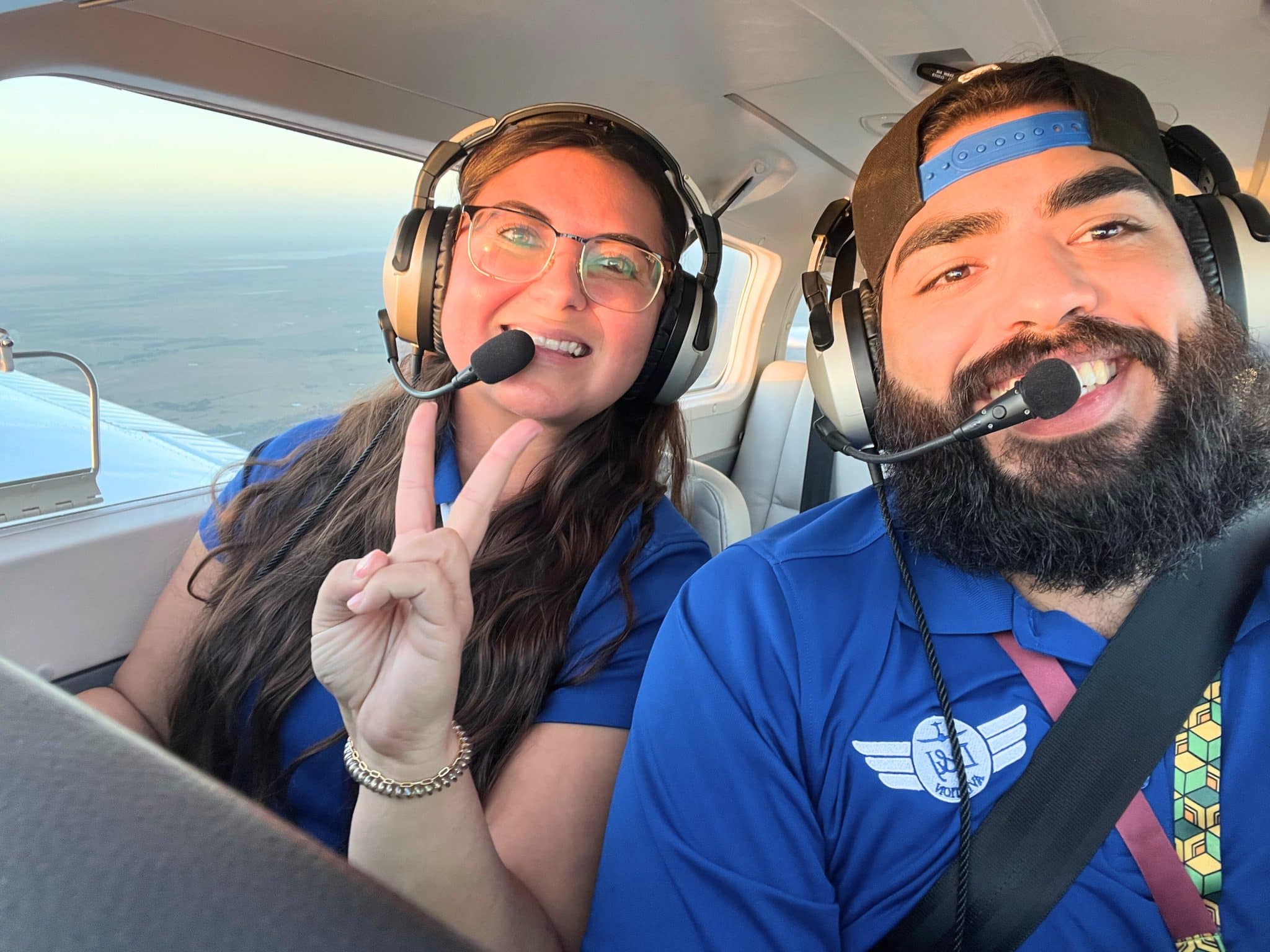
D&J Aviation Chief Pilot Leila and instructor Jorge flying N488DJ.
Sanford also gives us relatively quick access to training areas around Central Florida, so once you’re airborne, you can get to work without spending an unreasonable amount of your lesson getting somewhere useful.
THE FIRST FEW RADIO CALLS AT SANFORD WILL FEEL FAST. GIVE IT A COUPLE OF FLIGHTS. PRETTY SOON, GROUND, TOWER, AND APPROACH ARE JUST PART OF THE ROUTINE.
What I Would Look For in a Flight School Near KSFB
There are plenty of things you can compare between flight schools. Aircraft, instructors, facilities, rates, programs, financing, scheduling, and approximately 47 other things will probably end up on your list.
A few items deserve some extra attention.
Ask What Training Actually Costs
This is probably the biggest one.
The FAA establishes minimum flight-hour requirements for certificates and ratings. Those numbers are useful regulatory minimums, although they shouldn’t automatically become the number used to estimate what your training will cost.
Every student learns differently.
When you speak with a flight school, ask what their students actually average before completing a program. You should be able to get a reasonably realistic idea of total program cost based on real training data.
Finding out halfway through your Private Pilot training that your original estimate was wildly optimistic is a pretty unpleasant surprise.
At D&J, we build our program estimates using average student completion times so students have a more useful number from the beginning.
FLIGHT TRAINING IS TOO EXPENSIVE FOR MYSTERY MATH. ASK WHAT STUDENTS ACTUALLY AVERAGE, THEN BUILD YOUR BUDGET AROUND A NUMBER THAT MAKES SENSE.
Take a Good Look at the Fleet
You’re going to spend quite a few hours sitting inside these airplanes, so definitely look at them before enrolling.
Ask about the fleet size, aircraft availability, avionics, maintenance, and how many students are sharing those airplanes.
Modern glass avionics are especially valuable if aviation is something you plan to pursue professionally. Garmin G1000 systems and similar avionics are common throughout modern aviation, and getting familiar with that environment early gives you a strong foundation for instrument training and more advanced aircraft.
Aircraft availability matters just as much.
The fanciest airplane in Central Florida isn’t particularly useful to you if 25 students are all trying to schedule it at the same time.
Ask About Instructor Continuity
Flight instructors move on. It’s part of aviation.
Many CFIs are building experience toward airline or corporate flying careers, so occasionally your instructor is going to get the phone call they’ve been working toward.
A good school should have a process for handling that transition.
Ask how training records are maintained, how instructor handoffs work, and whether another instructor can reasonably continue your training without spending several flights figuring out where you are.
Consistency saves time, and in flight training, saving time generally saves money too.
Ask How the School Prepares Students for Checkrides
Getting a checkride date is only one piece of the process.
You also want to know how the school determines that you’re ready to take it.
Ask about mock checkrides, stage checks, instructor sign-offs, and the school’s general preparation process. Your checkride shouldn’t be the first time somebody other than your regular instructor takes a serious look at your flying.
Consider the Airport You’ll Be Training From
Airspace matters.
Students training at smaller non-towered airports can absolutely become excellent pilots. They’ll still need exposure to towered airports and controlled airspace during training.
When your home airport is KSFB, that exposure happens naturally.
Every departure, arrival, taxi instruction, traffic call, and frequency change builds experience. After enough repetition, communicating with ATC simply becomes another part of flying the airplane.
A GOOD FLIGHT SCHOOL SHOULD KEEP YOU FLYING, KEEP YOU PROGRESSING, AND HAVE A PLAN WHEN AIRPLANES, INSTRUCTORS, OR SCHEDULES CHANGE.
D&J Aviation at Sanford
Our Sanford campus is located at 1140 Spinner Lane in Sanford, directly on Orlando Sanford International Airport.
Sanford is the newer of our two Central Florida locations, with our original campus located at Apopka Airport (X04).
The two airports give students very different training environments. Apopka is a fantastic non-towered general aviation airport, while Sanford gives students the Class C and towered-airport experience we’ve been talking about.
At Sanford, we operate a mixed Piper training fleet that allows students to progress through multiple certificates and ratings without having to leave the school.
The Fleet
Our Sanford fleet includes two 2025 Piper Archer TXs equipped with Garmin G1000 NXi avionics and GFC 700 autopilots, along with additional Piper Archers, Piper Warriors, and Piper Seminoles.
The Warriors provide a cost-effective platform for primary training, while the Archers offer additional capability and modern avionics options.
When it’s time to start adding another engine to the equation, our Piper Seminoles are used for multi-engine training.
Having multiple aircraft types also gives us some flexibility when matching students with the aircraft that makes the most sense for their training goals and budget.
Training Programs
Students at Sanford can train through Private Pilot, Instrument, Commercial, and Multi-Engine ratings.
For students pursuing aviation professionally, our Airline Pilot Program provides a path from zero flight experience through CFI, CFI-I, and MEI.
We also operate our 5-Day Multi-Engine Program out of Sanford.
That program includes 12 hours of flight training and 25 hours of ground instruction packed into a focused week, along with guaranteed checkride scheduling. We regularly have pilots travel into Central Florida specifically for the program so they can complete their multi-engine add-on without stretching the training across several months.
Training Costs and Financing
Our Private Pilot Program currently averages around $15,380 based on actual student training averages.
Again, that’s important because very few students should build their financial plan around assuming they’ll finish at the FAA minimum.
Flight training is a significant investment, and you should understand what you’re getting into before you start.
We also offer in-house financing and work with lending partners for students who prefer to spread the cost of training out rather than paying for an entire program upfront.
Want the real numbers for your situation?
THE GOAL ISN’T JUST TO GET YOU THROUGH YOUR NEXT CHECKRIDE. WE WANT YOU TO LEAVE EACH PROGRAM A MORE CAPABLE, CONFIDENT PILOT.
Our Track Record
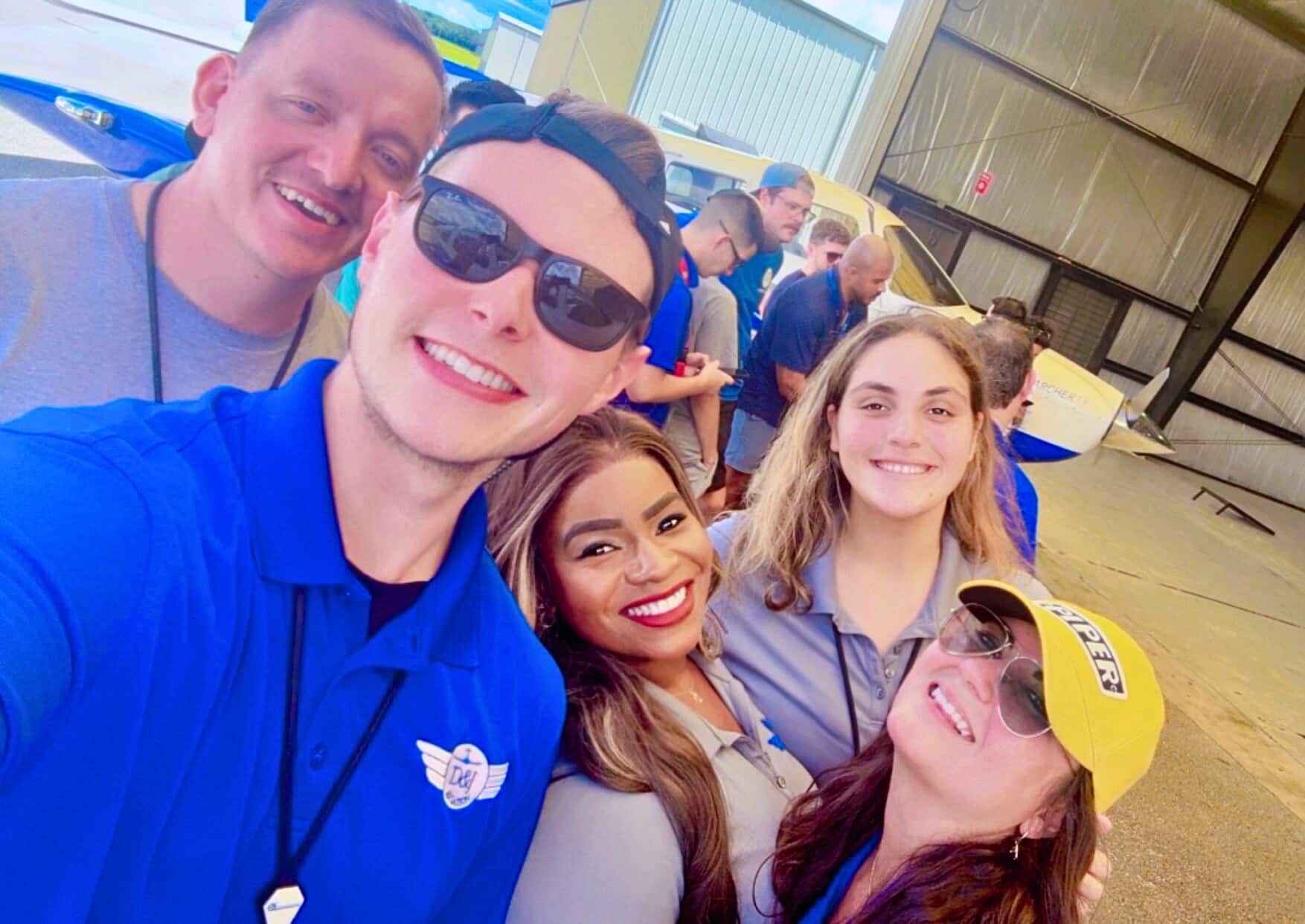
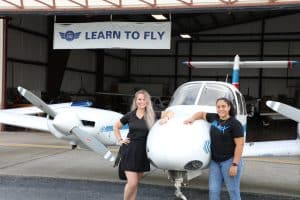
A few of the faces behind D&J Aviation’s Sanford operation.
D&J Aviation has been recognized as an AOPA Distinguished Flight School for four consecutive years, from 2023 through 2026.
Both our Sanford and Apopka locations have received that recognition individually.
We’re extremely proud of that, especially because it comes from feedback surrounding the student experience our team works hard to provide every day.
Awards are great. What matters most to us is what they represent: instructors, operations staff, maintenance personnel, and students all working together to make the training experience better.
Other Flight Training Options Near KSFB
We’re certainly not the only aviation operation around Sanford, and you should look around before deciding where to train.
Sanford Aircraft also provides flight training and aircraft maintenance directly at KSFB and has developed a following among local pilots and people looking to get into aviation.
There’s also Orlando Sanford Flying Club, which operates under a membership model and provides members access to IFR-equipped aircraft.
A flying club can make a lot of sense for someone who is already certificated and primarily looking for aircraft access or a way to build time.
For someone starting from zero or working through a structured certificate or rating, I’d pay close attention to instructor availability, curriculum, scheduling, and checkride preparation when comparing the two models.
Ultimately, your training environment needs to match what you’re trying to accomplish.
A Few Questions to Ask Before You Sign Up
Before committing to any flight school near Orlando Sanford International, I’d ask them a few pretty straightforward questions:
- What does the average student actually spend completing the program?
- How many flight hours does your average Private Pilot student have before their checkride?
- How many students are assigned to each instructor?
- What happens if my instructor leaves during training?
- How many aircraft are regularly available for students?
- How does your school determine when a student is checkride ready?
- What exposure will I get to towered airports and Class C airspace?
And go see the airplanes.
Seriously.
Sit inside one. Look around the facility. Meet an instructor. Talk to the operations staff. If possible, talk to a current student.
You can learn a surprising amount about a flight school within about 30 minutes of actually being there.
GO SEE THE AIRPLANES. MEET THE INSTRUCTORS. TALK TO THE PEOPLE BEHIND THE DESK. YOU CAN LEARN A LOT ABOUT A FLIGHT SCHOOL IN ABOUT 30 MINUTES.
Frequently Asked Questions
Is Orlando Sanford International a good airport to learn to fly at?
Absolutely. KSFB gives student pilots regular experience operating in towered Class C airspace and communicating with ATC.
That can feel busy during your first few lessons, although most students adapt pretty quickly. Eventually, talking with Ground, Tower, and Approach becomes another normal part of operating the aircraft.
How much does flight training cost near Sanford, FL?
Flight training costs vary based on the school, aircraft, instructor rates, and how many hours you personally need to reach proficiency.
At D&J Aviation’s Sanford campus, our Private Pilot Program currently averages approximately $15,380 based on actual student completion data.
Whenever you compare schools, ask for a complete written estimate and find out whether it is based on FAA minimum hours or real student averages.
That distinction can make a pretty significant difference.
Do I need flying experience before starting?
Nope!
Many of our students begin with zero flight experience.
A discovery flight is usually the best place to start. You’ll fly with an instructor, get some hands-on time with the airplane, see the airport, and get a much better idea of what flight training actually feels like.
It’s considerably more useful than watching another 37 YouTube videos about becoming a pilot.
How long does it take to earn a Private Pilot certificate in Sanford?
Students who train consistently three to four times per week can often complete their Private Pilot training in roughly three to six months.
Consistency is a huge part of that.
When there are long gaps between lessons, some of the next flight inevitably gets spent reviewing things you were already comfortable with a few weeks earlier.
Flying regularly helps you continue building on the previous lesson, which generally makes training more efficient.
Is KSFB difficult for a brand-new student pilot?
There’s definitely a little more going on than you’ll find at a quiet non-towered airport.
That’s also why training there can be so valuable.
You’ll learn how to communicate with ATC, follow taxi instructions, manage frequencies, maintain situational awareness, and operate around other traffic from your earliest lessons.
Your instructor handles the workload with you while you’re learning, and your involvement increases as your experience grows.
Pretty soon, the airport that seemed extremely busy on lesson one simply feels like home.
Ready to See Sanford for Yourself?
If you’re comparing flight schools near KSFB, come visit them.
Look at the airplanes. Meet the instructors. Ask questions. Get the pricing in writing.
We’d be happy to show you around D&J Aviation’s Sanford campus and talk through your goals, whether you’re thinking about earning a Private Pilot certificate for fun or planning to make aviation your career.
We offer discovery flights at both our Sanford and Apopka locations, so you can also experience the difference between training at a towered Class C airport and a non-towered airport for yourself.
[elementor-template id=”6
We’ll get you pointed in the right direction.